
Monitoring Vital Signs: the New Frontier of Well-being
How Was This Technology Developed?
Wearable sensors for monitoring vital signs are the result of years of research in medical technology. These devices combine:
- Miniaturized electronic components (such as ECG sensors, thermistors, accelerometers)
- Biocompatible materials designed for safe skin contact
- Wireless connectivity that enables real-time data transmission
Thanks to these features, continuous monitoring can be achieved without the need for wires, traditional electrodes, or bulky equipment.
What Is Vital Signs Monitoring?
In recent years, technological advancements have significantly improved healthcare, enabling us to continuously and discreetly observe some of the body’s most important indicators. These indicators—known as vital signs—include heart rate, respiratory rate, body temperature, and other physiological metrics.
Monitoring these data is no longer confined to hospital environments: today, wearable, lightweight, wireless devices allow continuous and less invasive observation, even outside of healthcare facilities.
How Does a Wearable System Work?
An example of wearable technology is a small sensor applied to the chest that automatically detects parameters such as:
- Electrical activity of the heart (electrocardiogram)
- Heart rate and respiratory rate
- Skin temperature
- Body posture
- Blood pressure and SPO2 (tertiary devices)
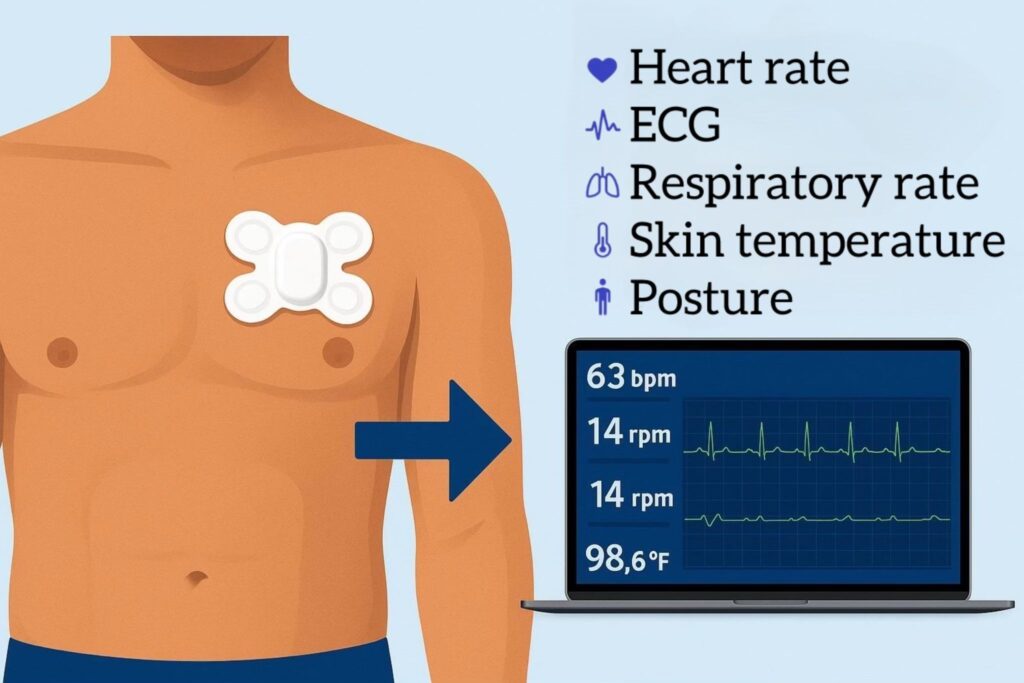
Additional tools like pulse oximeters or blood pressure monitors can also be connected wirelessly to the system.
All collected data is transmitted to a digital platform where authorized healthcare personnel can view and analyze it remotely.
Why Is Continuous Monitoring Useful?
Continuous monitoring can provide a more comprehensive and real-time view of an individual’s physiological condition. In certain clinical contexts, this approach can be useful for:
- Constantly collecting vital data without interrupting daily activities
- Reducing the need for in-person check-ups when clinically appropriate
- Supporting healthcare professionals in gathering objective remote data
All of this is done in full respect of privacy and data protection, through secure and encrypted systems.
In What Situations Can It Be Used?
Although it remains a device intended for professional use, the system can be used—when included in a care plan—in several situations:
- In hospitals, to monitor patients in wards
- In nursing homes, to better follow elderly or chronic patients
- In outpatient or home settings, when a doctor activates remote observation
- During rehabilitation programs, to monitor the progression of physiological conditions over time
Every use must be based on a physician’s recommendation as part of an appropriate care pathway.
Who Can Benefit from It?
This type of monitoring is used in clinical settings and may be applied, at the discretion of a healthcare provider, in various contexts: at home, in nursing facilities, outpatient clinics, or hospitals.
It is a technology designed to support care pathways by enabling the continuous, discreet, and non-invasive collection of health data.
What Are the Benefits for the Healthcare System?
The adoption of continuous monitoring systems can bring tangible benefits at the organizational level:
- Shorter hospital stays, thanks to remote monitoring
- More efficient use of hospital resources by enabling centralized monitoring
- Quicker response times due to automatic alerts and trend analysis
- Better management of fragile, chronic, or immobile patients
These solutions are increasingly integrated into regional and national strategies for a connected and sustainable digital healthcare system.
Toward a More Modern Healthcare System
The ability to remotely monitor vital signs is an important step toward a more modern and accessible healthcare system. These tools are intended for use only under medical supervision and in clinically appropriate contexts.